NFPA signals a path away from foam in aircraft hangars
BriefingAviationGlobal
The 2026 edition of NFPA 409 is now in force, and it points the same way as the Fire Protection Research Foundation’s Foam Firefighting Roadmap. Hangar owners have a defensible route to protection without foam, provided the risk case is documented and accepted by the AHJ and insurers.
By Kenny Lee, Archer (S) Pte Ltd5 min readAviation fire protection
Updated October 2026 for the published 2026 edition of NFPA 409, TIA 26-1 and current FM Global data sheets. First published September 2025.
In July 2025 the Fire Protection Research Foundation (FPRF), the research arm of the National Fire Protection Association (NFPA), published Phase II of its Foam Firefighting Roadmap.1 Its findings align closely with the revision of NFPA 409, Standard on Aircraft Hangars, which has since been issued as the 2026 edition and is now the current edition.2
Taken together, the two documents signal a clear shift in how hangar fire protection is approached: more flexibility, more reliance on risk-based thinking, and, for many facilities, a credible path away from foam where the risk case supports it.
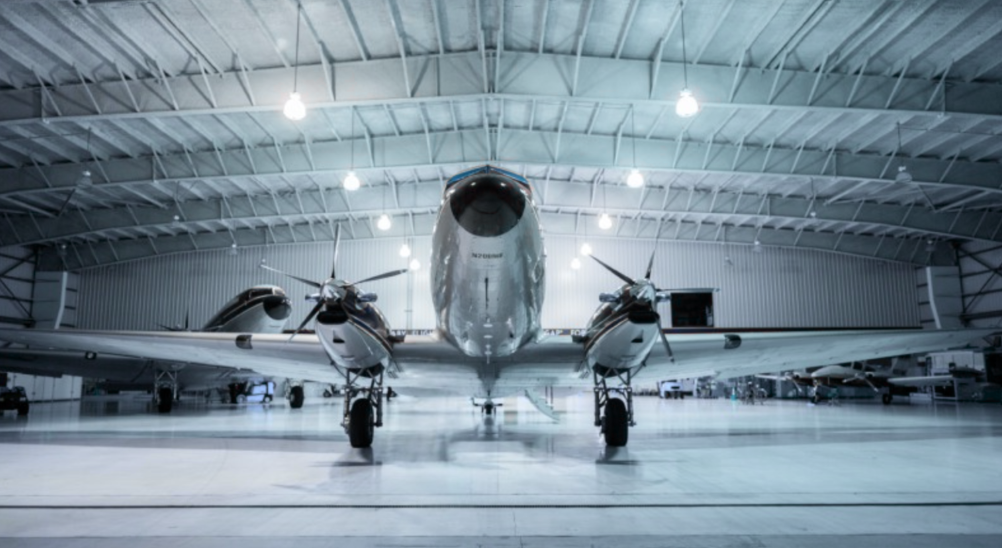
For airport owners, maintenance, repair and overhaul (MRO) providers and hangar operators, the change affects what they install, how they justify it, and who must agree to it. Foam systems have long been the default in hangars. The standard now accepts designs that use little or no foam, provided the owner can demonstrate the case to the authority having jurisdiction (AHJ), the body that approves the installation, and to the insurers.
Accidental discharge, not fire, drove the change
Before the 2022 edition of NFPA 409, hangars saw numerous accidental foam discharges, mostly from high-expansion foam systems. The foam involved was PFAS-free (free of per- and polyfluoroalkyl substances), yet the discharges caused major damage to aircraft and their contents. Research has shown that accidental discharges have historically far outweighed actual hangar fire events. A 2019 review by the University of Maryland’s Department of Fire Protection Engineering counted 3.7 times as many accidental foam discharges per year as discharges in response to fire, with losses from accidental discharges also 3.7 times greater.3
The damage risk was therefore the key driver for NFPA’s change in direction. Environmental concern over fluorinated foams was not.
The damage risk, not environmental concerns, was the driver for NFPA’s re-think.
Archer (S) Pte Ltd
How NFPA 409 has changed, and the 2026 edition
The 2022 edition restructured the standard in two ways. It allowed performance-based design (PBD), an engineered approach that proves equivalent safety without following the prescriptive requirements line by line. It also introduced Ignitable Liquid Drainage Floor Assemblies (ILDFA), flooring designed to collect and drain spilled fuel and so limit its spread. A literature review by the University of Maryland and Poole Fire Protection underpins this more performance-based direction.
The 2026 revision gives hangar owners three compliance pathways:
Prescriptive baseline. The legacy requirements, including foam.
Performance-based equivalency. Engineered designs that match or exceed the baseline.
Risk-based design. The owner selects protection features on the basis of a risk assessment, subject to approval by the AHJ and insurers.
The issued edition carries the risk-based route into the text. A new clause, 4.1.1, permits an alternative hangar group to be selected where a risk assessment, as outlined in Chapter 5, identifies that group as acceptable. For hangars housing aircraft that use fuels other than liquid hydrocarbons, 1.3.3.2 requires either a fire-risk-based approach or a performance-based design in accordance with Chapter 5.4 The edition also removes the requirement for column sprinklers where a foam system is not required.5
Owners should note that risk-based designs for commercial hangars usually require agreement from both the AHJ and the insurers, including the aircraft hull insurers.
Regulatory detailNFPA 409 (2026) amendments and the FM Global position
TIA 26-1, issued on 2 December 2025 and effective on 22 December 2025, amends 7.4.6.7, 7.5.4.10, 7.5.5.6, 7.5.12.2.4 (new) and 7.5.13.6. It concerns the K-factors of sprinklers and foam discharge devices; it does not change when foam is required.2
Insurers working to FM Global guidance already take a similar line. FM Global Data Sheet 7-93, Aircraft Hangars, in its July 2022 interim revision, makes an FM Approved ignitable liquid drainage floor assembly combined with ceiling-level sprinklers the primary protection recommendation for hangars with fueled aircraft (Section 2.4.2), with foam systems retained as alternatives (Section 2.4.3).6
BackgroundUnited States Department of Defense practice
The United States Air Force now installs fire suppression only in mission-critical hangars. The Naval Facilities Engineering Systems Command (NAVFAC) has moved its low-level trench grate nozzle systems to water-only discharge, and continues to study broader water-only solutions.
Across the Department of Defense (DoD), hangar fire protection strategies are moving away from foam. These two policies are useful references when proposing alternatives in commercial settings.
Regulatory detailWhere foam remains in the market
A few foam-based options remain. In September 2025 one commercial fluorine-free foam (FFF) was seeking FM Global approval for NAVFAC-style grate nozzles, and some FFF concentrates are listed for use with foam-water sprinklers. FM Global’s foam data sheet, Data Sheet 4-12 (April 2025 interim revision), names synthetic fluorine-free foam (SFFF) and alcohol-resistant SFFF as the concentrate types for new systems, and recognises high-expansion foam in aircraft hangars only when used together with sprinklers.7 The overall industry trend continues to follow the DoD: limit foam use, and use it only where justified.
What owners should settle at the start of a project
Foam-free strategies are now credible, provided the risk case is well documented and the stakeholders are aligned.
Choose the pathway early. Decide whether the project will follow the prescriptive, performance-based or risk-based route, and confirm expectations with the AHJ and the insurers at the outset.
Use ILDFA where fuel spills are credible. Removing liquid fuel from the aircraft bay strengthens a non-foam strategy. Combined with detection, manual response and exposure protection, ILDFA forms a credible basis for a performance-based submission.
If foam is used, contain the risk. Limit it to listed or approved configurations, match discharge devices exactly to their listings, and add measures against accidental discharge.
Plan training and drills. Emergency response procedures should reflect the chosen strategy. If a water-only system is adopted, first responders’ standard operating procedures need to be updated.
For ownersThree questions to answer before design starts
Which pathway, prescriptive, performance-based or risk-based, fits the hangar and its aircraft mix?
How will the risk of accidental discharge, set against the risk of a fire event, be presented to the insurers?
Can a water-only solution be justified, and what upgrades would support that case?
Where business or insurer constraints still require foam, it should be treated as the exception and kept strictly within its listing. Between the 2022 restructuring of NFPA 409 and the risk assessment route written into the 2026 edition, owners have a defensible route to hangar protection without foam.
The condition is the same on every pathway: the risk case has to be made in writing, and the AHJ and insurers have to accept it before the design is fixed.
Notes
Fire Protection Research Foundation, Firefighting Foams: Fire Service Roadmap 2025, Phase II, NFPA, 2025. Link. ↑
NFPA, Tentative Interim Amendment 26-1 to NFPA 409, Standard on Aircraft Hangars, 2026 Edition (TIA Log No. 1850), issued 2 December 2025, effective 22 December 2025, references 7.4.6.7, 7.5.4.10, 7.5.5.6, 7.5.12.2.4 and 7.5.13.6. Link. ↑
J. Milke, S. Behera, K. Lee and C. Slingluff, Review of Foam Fire Suppression System Discharges in Aircraft Hangars, Department of Fire Protection Engineering, University of Maryland, November 2019. Link. ↑
NFPA, NFPA 409 Second Draft Report (Fall 2025 revision cycle), Second Revision No. 7 (4.1.1, Alternative Hangar Group) and Second Revision No. 6 (1.3.3 to 1.3.3.3). Link. ↑
National Air Transportation Association, NFPA 409 (2026) Introduces Key NATA-Supported Updates to Aircraft Hangar Standards, 10 February 2026. Link. ↑
FM Global, Property Loss Prevention Data Sheet 7-93, Aircraft Hangars, Aircraft Manufacturing and Assembly Facilities, and Protection of Aircraft Interiors During Assembly, April 2017, interim revision July 2022, Sections 2.4.2 and 2.4.3. Link. ↑
FM Global, Property Loss Prevention Data Sheet 4-12, Foam Extinguishing Systems, April 2021, interim revision April 2025. Link. ↑
KL
Kenny Lee, CFPS
Director, Archer (S) Pte Ltd. Archer designs and tests fire protection for petrochemical, aviation and high-hazard industrial facilities across APAC and the Middle East.